Bill Gates
From Wikipedia, the free encyclopedia
William Henry "
Bill"
Gates III (born October 28, 1955)
[4] is an American
business magnate,
investor,
philanthropist, and author. Gates is the former CEO and current chairman of
Microsoft, the software company he founded with
Paul Allen. He is consistently ranked among the
world's wealthiest people[5] and was the wealthiest overall from 1995 to 2009, excluding 2008, when he was ranked third,
[6] in 2011 he was the wealthiest American and the second wealthiest person.
[7][8] During his career at Microsoft, Gates held the positions of CEO and
chief software architect, and remains the largest individual shareholder, with 6.4 percent of the
common stock.
[9] He has also authored or co-authored several books.
Gates is one of the best-known
entrepreneurs of the personal computer revolution. Gates has been
criticized for his business tactics, which have been considered anti-competitive, an opinion which has in some cases been upheld by the courts.
[10][11]
In the later stages of his career, Gates has pursued a number of
philanthropic endeavors, donating large amounts of money to various
charitable organizations and scientific research programs through the
Bill & Melinda Gates Foundation, established in 2000.
[12]
Gates stepped down as chief executive officer of Microsoft in January
2000. He remained as chairman and created the position of chief
software architect. In June 2006, Gates announced that he would be
transitioning from full-time work at Microsoft to part-time work, and
full-time work at the Bill & Melinda Gates Foundation. He gradually
transferred his duties to
Ray Ozzie, chief software architect, and
Craig Mundie,
chief research and strategy officer. Gates' last full-time day at
Microsoft was June 27, 2008. He remains at Microsoft as non-executive
chairman.
Early life

Bill Gates was photographed by the Albuquerque, New Mexico police in
1977 after a traffic violation (details of which have been lost over
time).
Gates was born in
Seattle, Washington, to
William H. Gates, Sr. and
Mary Maxwell Gates. His parents are of English,
German, and Scots-Irish descent.
[13][14] His father was a prominent lawyer, and his mother served on the board of directors for
First Interstate BancSystem and the
United Way. Gates's maternal grandfather was J. W. Maxwell, a
national bank
president. Gates has one elder sister, Kristi (Kristianne), and one
younger sister, Libby. He was the fourth of his name in his family, but
was known as William Gates III or "Trey" because his father had the "II"
suffix.
[15] Early on in his life, Gates' parents had a law career in mind for him.
[16] When Gates was young, his family regularly attended a
Congregational church.
[17][18][19]
At 13 he enrolled in the
Lakeside School, an exclusive preparatory school.
[20] When he was in the eighth grade, the Mothers Club at the school used proceeds from Lakeside School's
rummage sale to buy a
Teletype Model 33 ASR terminal and a block of computer time on a
General Electric (GE) computer for the school's students.
[21] Gates took an interest in programming the GE system in
BASIC,
and was excused from math classes to pursue his interest. He wrote his
first computer program on this machine: an implementation of
tic-tac-toe
that allowed users to play games against the computer. Gates was
fascinated by the machine and how it would always execute software code
perfectly. When he reflected back on that moment, he said, "There was
just something neat about the machine."
[22] After the Mothers Club donation was exhausted, he and other students sought time on systems including
DEC PDP minicomputers. One of these systems was a
PDP-10 belonging to Computer Center Corporation (CCC), which banned four Lakeside students—Gates,
Paul Allen,
Ric Weiland, and Kent Evans—for the summer after it caught them exploiting bugs in the
operating system to obtain free computer time.
[23]
At the end of the ban, the four students offered to find bugs in
CCC's software in exchange for computer time. Rather than use the system
via Teletype, Gates went to CCC's offices and studied
source code for various programs that ran on the system, including programs in
FORTRAN,
LISP, and
machine language.
The arrangement with CCC continued until 1970, when the company went
out of business. The following year, Information Sciences, Inc. hired
the four Lakeside students to write a payroll program in
COBOL,
providing them computer time and royalties. After his administrators
became aware of his programming abilities, Gates wrote the school's
computer program to schedule students in classes. He modified the code
so that he was placed in classes with mostly female students. He later
stated that "it was hard to tear myself away from a machine at which I
could so unambiguously demonstrate success."
[22] At age 17, Gates formed a venture with Allen, called
Traf-O-Data, to make
traffic counters based on the
Intel 8008 processor.
[24] In early 1973, Bill Gates served as a congressional page in the U.S. House of Representatives.
[25]
Gates graduated from Lakeside School in 1973. He scored 1590 out of 1600 on the
SAT[26] and enrolled at
Harvard College in the autumn of 1973.
[27] While at Harvard, he met
Steve Ballmer, who later succeeded Gates as CEO of Microsoft.
In his sophomore year, Gates devised an algorithm for
pancake sorting as a solution to one of a series of unsolved problems
[28] presented in a
combinatorics class by
Harry Lewis, one of his professors. Gates' solution held the record as the fastest version for over thirty years;
[28][29] its successor is faster by only one percent.
[28] His solution was later formalized in a published paper in collaboration with Harvard computer scientist
Christos Papadimitriou.
[30]
Gates did not have a definite study plan while a student at Harvard
[31]
and spent a lot of time using the school's computers. Gates remained in
contact with Paul Allen, and he joined him at Honeywell during the
summer of 1974.
[32] The following year saw the release of the
MITS Altair 8800 based on the
Intel 8080 CPU, and Gates and Allen saw this as the opportunity to start their own computer software company.
[33]
He had talked this decision over with his parents, who were supportive
of him after seeing how much Gates wanted to start a company.
[31]
Microsoft
BASIC

MITS Altair 8800 Computer with 8-inch (200 mm) floppy disk system
After reading the January 1975 issue of
Popular Electronics that demonstrated the
Altair 8800, Gates contacted
Micro Instrumentation and Telemetry Systems (MITS), the creators of the new microcomputer, to inform them that he and others were working on a
BASIC interpreter for the platform.
[34]
In reality, Gates and Allen did not have an Altair and had not written
code for it; they merely wanted to gauge MITS's interest. MITS president
Ed Roberts agreed to meet them for a demo, and over the course of a few weeks they developed an Altair
emulator
that ran on a minicomputer, and then the BASIC interpreter. The
demonstration, held at MITS's offices in Albuquerque, was a success and
resulted in a deal with MITS to distribute the interpreter as
Altair BASIC. Paul Allen was hired into MITS,
[35]
and Gates took a leave of absence from Harvard to work with Allen at
MITS in Albuquerque in November 1975. They named their partnership
"Micro-Soft" and had their first office located in Albuquerque.
[35]
Within a year, the hyphen was dropped, and on November 26, 1976, the
trade name "Microsoft" was registered with the Office of the Secretary
of the State of New Mexico.
[35] Gates never returned to Harvard to complete his studies.
Microsoft's BASIC was popular with computer hobbyists, but Gates
discovered that a pre-market copy had leaked into the community and was
being widely copied and distributed. In February 1976, Gates wrote an
Open Letter to Hobbyists
in the MITS newsletter saying that MITS could not continue to produce,
distribute, and maintain high-quality software without payment.
[36]
This letter was unpopular with many computer hobbyists, but Gates
persisted in his belief that software developers should be able to
demand payment. Microsoft became independent of MITS in late 1976, and
it continued to develop programming language software for various
systems.
[35] The company moved from Albuquerque to its new home in
Bellevue, Washington on January 1, 1979.
[34]
During Microsoft's early years, all employees had broad
responsibility for the company's business. Gates oversaw the business
details, but continued to write code as well. In the first five years,
Gates personally reviewed every line of code the company shipped, and
often rewrote parts of it as he saw fit.
[37]
IBM partnership
IBM approached Microsoft in July 1980 regarding its upcoming personal computer, the
IBM PC.
[38]
The computer company first proposed that Microsoft write the BASIC
interpreter. When IBM's representatives mentioned that they needed an
operating system, Gates referred them to
Digital Research (DRI), makers of the widely used
CP/M operating system.
[39]
IBM's discussions with Digital Research went poorly, and they did not
reach a licensing agreement. IBM representative Jack Sams mentioned the
licensing difficulties during a subsequent meeting with Gates and told
him to get an acceptable operating system. A few weeks later Gates
proposed using
86-DOS (QDOS), an operating system similar to CP/M that
Tim Paterson of
Seattle Computer Products
(SCP) had made for hardware similar to the PC. Microsoft made a deal
with SCP to become the exclusive licensing agent, and later the full
owner, of 86-DOS. After adapting the operating system for the PC,
Microsoft delivered it to IBM as
PC-DOS in exchange for a one-time fee of $50,000.
[40]
Gates did not offer to transfer the
copyright on the operating system, because he believed that other hardware vendors would clone IBM's system.
[40] They did, and the sales of
MS-DOS made Microsoft a major player in the industry.
[41]
Despite IBM's name on the operating system the press quickly identified
Microsoft as being very influential on the new computer, with
PC Magazine asking if Gates were "The Man Behind The Machine?"
[38]
He oversaw Microsoft's company restructuring on June 25, 1981, which
re-incorporated the company in Washington state and made Gates President
of Microsoft and the Chairman of the Board.
[34]
Windows
Microsoft launched its first retail version of
Microsoft Windows on November 20, 1985, and in August, the company struck a deal with
IBM to develop a separate operating system called
OS/2.
Although the two companies successfully developed the first version of
the new system, mounting creative differences caused the partnership to
deteriorate. It ended in 1991 when Gates led Microsoft to develop a
version of OS/2 independently from IBM.
[42]
Management style
From Microsoft's founding in 1975 until 2006, Gates had primary
responsibility for the company's product strategy. He aggressively
broadened the company's range of products, and wherever Microsoft
achieved a dominant position he vigorously defended it. He gained a
reputation for being distant to others; as early as 1981 an industry
executive complained in public that "Gates is notorious for not being
reachable by phone and for not returning phone calls."
[43]
As an executive, Gates met regularly with Microsoft's senior managers
and program managers. Firsthand accounts of these meetings describe him
as verbally combative, berating managers for perceived holes in their
business strategies or proposals that placed the company's long-term
interests at risk.
[44][45] He often interrupted presentations with such comments as, "That's the stupidest thing I've ever heard!"
[46] and, "Why don't you just give up your
options and join the
Peace Corps?"
[47] The target of his outburst then had to defend the proposal in detail until, hopefully, Gates was fully convinced.
[46] When subordinates appeared to be procrastinating, he was known to remark sarcastically, "I'll do it over the weekend."
[48][49][50]
Gates' role at Microsoft for most of its history was primarily a
management and executive role. However, he was an active software
developer in the early years, particularly on the company's
programming language products. He has not officially been on a development team since working on the
TRS-80 Model 100,
[51] but wrote code as late as 1989 that shipped in the company's products.
[49]
On June 15, 2006, Gates announced that he would transition out of his
day-to-day role over the next two years to dedicate more time to
philanthropy. He divided his responsibilities between two successors,
placing
Ray Ozzie in charge of day-to-day management and
Craig Mundie in charge of long-term product strategy.
[52]
Antitrust litigation

Bill Gates giving his deposition at Microsoft on August 27, 1998
Many decisions that led to
antitrust litigation over Microsoft's business practices have had Gates' approval. In the 1998
United States v. Microsoft case, Gates gave deposition testimony that several journalists characterized as evasive. He argued with examiner
David Boies over the contextual meaning of words like "compete", "concerned" and "we".
[53] BusinessWeek reported:
Early rounds of his deposition show him offering obfuscatory answers
and saying 'I don't recall,' so many times that even the presiding judge
had to chuckle. Worse, many of the technology chief's denials and pleas
of ignorance were directly refuted by prosecutors with snippets of
e-mail that Gates both sent and received.[54]
Gates later said he had simply resisted attempts by Boies to
mischaracterize his words and actions. As to his demeanor during the
deposition, he said, "Did I fence with Boies? ... I plead guilty.
Whatever that penalty is should be levied against me: rudeness to Boies
in the first degree."
[55] Despite Gates's denials, the judge ruled that Microsoft had committed
monopolization and
tying, and blocking competition, both in violation of the
Sherman Antitrust Act.
[55]
Appearance in ads
Gates appeared in a series of ads to promote Microsoft in 2008. The first commercial, co-starring
Jerry Seinfeld,
is a 90-second talk between strangers as Seinfeld walks up on a
discount shoe store (Shoe Circus) in a mall and notices Gates buying
shoes inside. The salesman is trying to sell Mr. Gates shoes that are a
size too big. As Gates is buying the shoes, he holds up his discount
card, which uses a slightly altered version of his own mugshot of his
arrest in
New Mexico in 1977 for a traffic violation.
[56]
As they are walking out of the mall, Seinfeld asks Gates if he has
melded his mind to other developers, after getting a yes, he then asks
if they are working on a way to make computers edible, again getting a
yes. Some say that this is an homage to Seinfeld's own show about
"nothing" (
Seinfeld).
[57]
In a second commercial in the series, Gates and Seinfeld are at the
home of an average family trying to fit in with normal people.
Post-Microsoft
Since leaving Microsoft, Gates continues his philanthropy and, among other projects, purchased the video rights to the
Messenger Lectures series called
The Character of Physical Law, given at
Cornell University by
Richard Feynman in 1964 and recorded by the BBC. The videos are available online to the public at Microsoft's
Project Tuva.
[58][59]
In April 2010, Gates was invited to visit and speak at the
Massachusetts Institute of Technology where he asked the students to take on the hard problems of the world in their futures.
[60][61]
Personal life
Gates married Melinda French on January 1, 1994. They have two daughters,
Jennifer Katharine Gates (1996) and Phoebe Adele (2002), and one son, Rory John (1999).
The Gates's home is an
earth-sheltered house in the side of a hill overlooking
Lake Washington in Medina. According to
King County
public records, as of 2006 the total assessed value of the property
(land and house) is $125 million, and the annual property tax is
$991,000.
His 66,000 sq ft (6,100 m
2) estate has a 60-foot (18 m) swimming pool with an underwater music system, as well as a 2,500 sq ft (230 m
2) gym and a 1,000 sq ft (93 m
2) dining room.
[62]
Also among Gates' private acquisitions is the
Codex Leicester, a collection of writings by
Leonardo da Vinci, which Gates bought for $30.8 million at an auction in 1994.
[63] Gates is also known as an avid reader, and the ceiling of his large home library is engraved with a quotation from
The Great Gatsby.
[64] He also enjoys playing bridge, tennis, and golf.
[65][66]
Gates was number one on the
Forbes 400 list from 1993 through to 2007 and number one on
Forbes list of
The World's Richest People
from 1995 to 2007 and 2009. In 1999, Gates's wealth briefly surpassed
$101 billion, causing the media to call him a "centibillionaire".
[67] Since 2000, the nominal value of his Microsoft holdings has declined due to a fall in Microsoft's stock price after the
dot-com bubble
burst and the multi-billion dollar donations he has made to his
charitable foundations. In a May 2006 interview, Gates commented that he
wished that he were not the richest man in the world because he
disliked the attention it brought.
[68]
Gates has several investments outside Microsoft, which in 2006 paid him
a salary of $616,667 and $350,000 bonus totalling $966,667.
[69] He founded
Corbis, a digital imaging company, in 1989. In 2004 he became a director of
Berkshire Hathaway, the investment company headed by long-time friend
Warren Buffett.
[70] In March 2010 Bill Gates was bumped down to the second wealthiest man behind
Carlos Slim.
Philanthropy
Gates began to appreciate the expectations others had of him when
public opinion mounted suggesting that he could give more of his wealth
to charity. Gates studied the work of
Andrew Carnegie and
John D. Rockefeller,
and in 1994 sold some of his Microsoft stock to create the William H.
Gates Foundation. In 2000, Gates and his wife combined three family
foundations into one to create the charitable
Bill & Melinda Gates Foundation, which is the largest transparently operated charitable foundation in the world.
[71]
The foundation allows benefactors access to information regarding how
its money is being spent, unlike other major charitable organizations
such as the
Wellcome Trust.
[72][73] The generosity and extensive philanthropy of
David Rockefeller
has been credited as a major influence. Gates and his father met with
Rockefeller several times, and modeled their giving in part on the
Rockefeller family's philanthropic focus, namely those global problems that are ignored by governments and other organizations.
[74]
As of 2007, Bill and Melinda Gates were the second-most generous
philanthropists in America, having given over $28 billion to charity.
[75] They plan to eventually give 95% of their wealth to charity.
[76]
The foundation was at the same time criticized because it invests
assets that it has not yet distributed with the exclusive goal of
maximizing
return on investment.
As a result, its investments include companies that have been charged
with worsening poverty in the same developing countries where the
Foundation is attempting to relieve poverty. These include companies
that pollute heavily, and pharmaceutical companies that do not sell into
the developing world.
[77] In response to press criticism, the foundation announced in 2007 a review of its investments, to assess social responsibility.
[78]
It subsequently canceled the review and stood by its policy of
investing for maximum return, while using voting rights to influence
company practices.
[79] The Gates Millennium Scholars program has been criticized for its exclusion of
Caucasian students.
[80][81]
Gates's wife urged people to learn a lesson from the philanthropic
efforts of the Salwen family, which had sold its home and given away
half of its value, as detailed in
The Power of Half.
[82]
Gates and his wife invited Joan Salwen to Seattle to speak about what
the family had done, and on December 9, 2010, Gates, investor
Warren Buffett, and
Mark Zuckerberg (Facebook's CEO) signed a promise they called the "Gates-Buffet
Giving Pledge", in which they promised to donate to charity at least half of their wealth over the course of time.
[83][84][85]
Recognition
In 1987, Gates was officially declared a billionaire in the pages of
Forbes' 400 Richest People in America issue, just days before his 32nd
birthday. As the world's youngest self-made billionaire, he was worth
$1.25 billion, over $900 million more than he'd been worth the year
before, when he'd debuted on the list.
[86]

Bill Gates and
Steve Jobs at the fifth
D: All Things Digital conference (
D5) in 2007
Time magazine named Gates
one of the 100 people who most influenced the 20th century, as well as
one of the 100 most influential people of 2004, 2005, and 2006.
Time also collectively named Gates, his wife Melinda and U2's lead singer
Bono as the 2005
Persons of the Year for their humanitarian efforts.
[87] In 2006, he was voted eighth in the list of "Heroes of our time".
[88] Gates was listed in the
Sunday Times power list in 1999, named CEO of the year by
Chief Executive Officers magazine in 1994, ranked number one in the "Top 50 Cyber Elite" by
Time in 1998, ranked number two in the
Upside Elite 100 in 1999 and was included in
The Guardian as one of the "Top 100 influential people in media" in 2001.
[89]
In 1994, he was honoured as the twentieth
Distinguished Fellow of the
British Computer Society. Gates has received honorary doctorates from
Nyenrode Business Universiteit,
Breukelen, The Netherlands, in 2000;
[90] the
Royal Institute of Technology, Stockholm, Sweden, in 2002; invited in 2003 to deliver the keynote address
[91] of the Golden Jubilee of the
Indian Institute of Technology,held in San Jose, California;
[92] Waseda University, Tokyo, Japan, in 2005;
Tsinghua University, Beijing, China, in April 2007;
[93] Harvard University in June 2007;
[94] the
Karolinska Institutet, Stockholm, in January 2008,
[95] and Cambridge University in June 2009.
[96] He was also made an honorary trustee of
Peking University in 2007.
[97] Gates was also made an
honorary Knight Commander of the Order of the British Empire (KBE) by
Queen Elizabeth II in 2005,
[98] in addition to having
entomologists name the Bill Gates flower fly,
Eristalis gatesi, in his honor.
[99]
In November 2006, he and his wife were awarded the
Order of the Aztec Eagle
for their philanthropic work around the world in the areas of health
and education, particularly in Mexico, and specifically in the program "
Un país de lectores".
[100] In October 2009, it was announced that Gates will be awarded the
2010 Bower Award for Business Leadership of
The Franklin Institute for his achievements in business and for his philanthropic work. In 2010 he was honored with the
Silver Buffalo Award by the
Boy Scouts of America, its highest award for adults, for his service to youth.
[101]
In 2011, Bill Gates was ranked as the fifth most powerful person in the world, according to rankings by Forbes magazine.
[102]
Investments
- Cascade Investments LLC,
a private investment and holding company, incorporated in United
States, is controlled by Bill Gates, and is headquartered in the city of
Kirkland, Washington.
- bgC3, a new think-tank company founded by Bill Gates.
- Corbis, a digital image licensing and rights services company.
- TerraPower, a nuclear reactor design company.
Books and films
To date, Bill Gates has authored two books.
The Road Ahead, written with Microsoft executive
Nathan Myhrvold and journalist
Peter Rinearson,
was published in November 1995, and it summarized the implications of
the personal computing revolution and described a future profoundly
changed by the arrival of a global
information superhighway.
Business @ the Speed of Thought
was published in 1999, and discusses how business and technology are
integrated, and shows how digital infrastructures and information
networks can help getting an edge on the competition.
Gates has appeared in a number of documentaries, including the 2010 documentary film
Waiting for "Superman"[103], and the BBC documentary series
The Virtual Revolution.
Gates was prominently featured in
Pirates of Silicon Valley, a 1999 film which chronicles the rise of
Apple and Microsoft from the early 1970s to 1997. He was portrayed by
Anthony Michael Hall.


 US$ 59


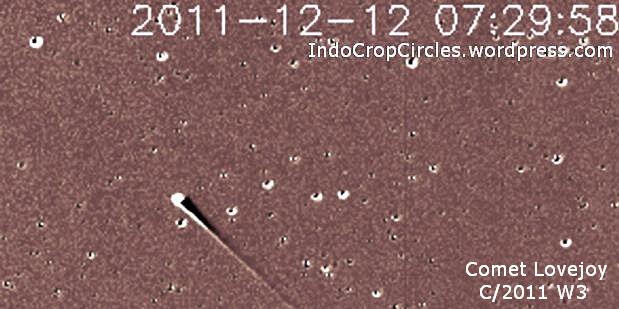


 Tapi
kemudian komet dapat bertahan berada di dekat korona matahari selama
lebih dari satu jam! Di dalam suhu beberapa juta derajat!
Tapi
kemudian komet dapat bertahan berada di dekat korona matahari selama
lebih dari satu jam! Di dalam suhu beberapa juta derajat!
 “This morning, an armada of spacecraft
witnessed something that many experts thought impossible. Comet Lovejoy
flew through the hot atmosphere of the sun and emerged intact.”
“This morning, an armada of spacecraft
witnessed something that many experts thought impossible. Comet Lovejoy
flew through the hot atmosphere of the sun and emerged intact.”


